Abstract Expressionism
Abstract expressionism was an American post–World War II art movement. It was the first specifically American movement to achieve international influence and put New York City at the center of the western art world, a role formerly filled by Paris. Although the term "abstract expressionism" was first applied to American art in 1946 by the art critic Robert Coates, it had been first used in Germany in 1919 in the magazine Der Sturm, regarding German Expressionism. In the United States, Alfred Barr was the first to use this term in 1929 in relation to works by Wassily Kandinsky.The movement's name is derived from the combination of the emotional intensity and self-denial of the German Expressionists with the anti-figurative aesthetic of the European abstract schools such as Futurism, the Bauhaus and Synthetic Cubism. Additionally, it has an image of being rebellious, anarchic, highly idiosyncratic and, some feel, nihilistic.
Style

An abstract expressionist painting by Jane Frank (1918-1986): Crags and Crevices, 1961
The movement's name is derived from the combination of the emotional intensity and self-denial of the German Expressionists with the anti-figurative aesthetic of the European abstract schools such as Futurism, the Bauhaus and Synthetic Cubism. Additionally, it has an image of being rebellious, anarchic, highly idiosyncratic and, some feel, nihilistic. In practice, the term is applied to any number of artists working (mostly) in New York who had quite different styles and even to work that is neither especially abstract nor expressionist. California Abstract Expressionist Jay Meuser, who typically painted in the non-objective style, wrote about his painting Mare Nostrum, "It is far better to capture the glorious spirit of the sea than to paint all of its tiny ripples." Pollock's energetic "action paintings", with their "busy" feel, are different, both technically and aesthetically, from the violent and grotesque Women series of Willem de Kooning's figurative paintings and the rectangles of color in Mark Rothko's Color Field paintings (which are not what would usually be called expressionist and which Rothko denied were abstract). Yet all four artists are classified as abstract expressionists.
 Abstract expressionism has many stylistic similarities to the Russian artists of the early twentieth century such as Wassily Kandinsky.
Although it is true that spontaneity or the impression of spontaneity
characterized many of the abstract expressionists works, most of these
paintings involved careful planning, especially since their large size
demanded it. With artists like Paul Klee, Wassily Kandinsky, Emma Kunz, and later on Rothko, Barnett Newman, and Agnes Martin, abstract art clearly implied expression of ideas concerning the spiritual, the unconscious and the mind.
Abstract expressionism has many stylistic similarities to the Russian artists of the early twentieth century such as Wassily Kandinsky.
Although it is true that spontaneity or the impression of spontaneity
characterized many of the abstract expressionists works, most of these
paintings involved careful planning, especially since their large size
demanded it. With artists like Paul Klee, Wassily Kandinsky, Emma Kunz, and later on Rothko, Barnett Newman, and Agnes Martin, abstract art clearly implied expression of ideas concerning the spiritual, the unconscious and the mind.Why this style gained mainstream acceptance in the 1950s is a matter of debate. American social realism had been the mainstream in the 1930s. It had been influenced not only by the Great Depression but also by the muralists of Mexico such as David Alfaro Siqueiros and Diego Rivera. The political climate after World War II did not long tolerate the social protests of these painters. Abstract expressionism arose during World War II and began to be showcased during the early forties at galleries in New York like The Art of This Century Gallery. The McCarthy era after World War II was a time of artistic censorship in the United States, but if the subject matter were totally abstract then it would be seen as apolitical, and therefore safe. Or if the art was political, the message was largely for the insiders.
While the movement is closely associated with painting, and painters like Arshile Gorky, Franz Kline, Clyfford Still, Hans Hofmann, Willem de Kooning, Jackson Pollock and others, collagist Anne Ryan and sculpture and certain sculptors in particular were
also integral to Abstract Expressionism. David Smith, and his wife Dorothy Dehner, Herbert Ferber, Isamu Noguchi, Ibram Lassaw, Theodore Roszak, Phillip Pavia, Mary Callery, Richard Stankiewicz, Louise Bourgeois, and Louise Nevelson in particular were some of the sculptors considered as being important members of the movement. In addition, the artists David Hare, John Chamberlain, James Rosati, Mark di Suvero, and sculptors Richard Lippold, Herbert Ferber, Raoul Hague, George Rickey, Reuben Nakian, and even Tony Smith, Seymour Lipton, Joseph Cornell, and several others were integral parts of the Abstract expressionist movement. Many of the sculptors listed participated in the Ninth Street Show the famous exhibition curated by Leo Castelli on East Ninth Street in New York City in 1951. Besides the painters and sculptors of the period the New York School of Abstract expressionism also generated a number of supportive poets, like Frank O'Hara and photographers like Aaron Siskind and Fred McDarrah, (whose book The Artist's World in Pictures documented the New York School during the 1950s), and filmmakers — notably Robert Frank — as well.
Although the abstract expressionist school spread quickly throughout the United States, the major centers of this style were New York City and the San Francisco Bay area of California.
Art critics of the post–World War II era

| “ | At a certain moment the canvas began to appear to one American painter after another as an arena in which to act. What was to go on the canvas was not a picture but an event. | ” |
While New York and the world were yet unfamiliar with the New York avant-garde by the late 1940s, most of the artists who have become household names today had their well established patron critics: Clement Greenberg advocated Jackson Pollock and the color field painters like Clyfford Still, Mark Rothko, Barnett Newman, Adolph Gottlieb and Hans Hofmann. Harold Rosenberg seemed to prefer the action painters like Willem de Kooning, and Franz Kline, as well as the seminal paintings of Arshile Gorky. Thomas B. Hess, the managing editor of ARTnews, championed Willem de Kooning.
The new critics elevated their protégés by casting other artists as "followers" or ignoring those who did not serve their promotional goal.
In 1958, Mark Tobey "became the first American painter since Whistler (1895) to win top prize at the Venice Biennale.
 Barnett Newman, a late member of the Uptown Group,
wrote catalogue forewords and reviews, and by the late 1940s became an
exhibiting artist at Betty Parsons Gallery. His first solo show was in
1948. Soon after his first exhibition, Barnett Newman remarked in one of
the Artists' Session at Studio 35: "We are in the process of making the
world, to a certain extent, in our ow
Barnett Newman, a late member of the Uptown Group,
wrote catalogue forewords and reviews, and by the late 1940s became an
exhibiting artist at Betty Parsons Gallery. His first solo show was in
1948. Soon after his first exhibition, Barnett Newman remarked in one of
the Artists' Session at Studio 35: "We are in the process of making the
world, to a certain extent, in our own image." Utilizing his writing skills, Newman fought every step of the way to reinforce his newly established image as an artist and to promote his work. An example is his letter on April 9, 1955, "Letter to Sidney Janis: — it is true that Rothko talks the fighter. He fights, however, to submit to the philistine world. My struggle against bourgeois society has involved the total rejection of it.
Strangely the person thought to have had most to do with the promotion of this style was a New York Trotskyite Clement Greenberg. As long time art critic for the Partisan Review and The Nation, he became an early and literate proponent of abstract expressionism. The well-heeled artist Robert Motherwell joined Greenberg in promoting a style that fit the political climate and the intellectual rebelliousness of the era.
Clement Greenberg proclaimed abstract expressionism and Jackson Pollock in particular as the epitome of aesthetic value. It supported Pollock's work on formalistic grounds as simply the best painting of its day and the culmination of an art tradition going back via Cubism and Cézanne to Monet, in which painting became ever 'purer' and more concentrated in what was 'essential' to it, the making of marks on a flat surface.
Jackson Pollock's work has always polarised critics. Harold Rosenberg spoke of the transformation of painting into an existential drama in Pollock's work, in which "what was to go on the canvas was not a picture but an event". "The big moment came when it was decided to paint 'just to paint'. The gesture on the canvas was a gesture of liberation from value — political, aesthetic, moral."
One of the most vocal critics of abstract expressionism at the time was New York Times art critic John Canaday. Meyer Schapiro, and Leo Steinberg along with Clement Greenberg and Harold Rosenberg were important art historians of the post-war era who voiced support for abstract expressionism. During the early to mid sixties younger art critics Michael Fried, Rosalind Krauss and Robert Hughes added considerable insights into the critical dialectic that continues to grow around abstract expressionism.
Consequences

Mark di Suvero, Aurora, 1992-1993
However, many painters, such as Jules Olitski, Joan Mitchell (a one-time pupil of Hans Hofmann), and Antoni Tàpies continued to work in the abstract expressionist style for many years, extending and expanding its visual and philosophical implications, as many abstract artists continue to do today, in styles described as Lyrical Abstraction, Neo-expressionist and others.
In the years after World War II, a group of New York artists started one of the first true schools of artists in America, bringing about a new era in American artwork: Abstract Expressionism. This led to the American art boom that brought about styles such as Pop Art. This also helped to make New York into a cultural and artistic hub.
Jackson Pollock
Paul Jackson Pollock (January 28, 1912 – August 11, 1956), known as Jackson Pollock, was an influential American painter and a major figure in the abstract expressionist movement. He was well known for his uniquely defined style of drip painting.During his lifetime, Pollock enjoyed considerable fame and notoriety. He was regarded as a mostly reclusive artist. He had a volatile personality, and struggled with alcoholism for most of his life. In 1945, he married the artist Lee Krasner, who became an important influence on his career and on his legacy.
 Pollock died at the age of 44 in an alcohol-related car accident. In
December 1956, the year of his death, he was given a memorial
retrospective exhibition at the Museum of Modern Art (MoMA) in New York City,
and a larger more comprehensive exhibition there in 1967. More
recently, in 1998 and 1999, his work was honored with large-scale
retrospective exhibitions at MoMA and at The Tate in London.
Pollock died at the age of 44 in an alcohol-related car accident. In
December 1956, the year of his death, he was given a memorial
retrospective exhibition at the Museum of Modern Art (MoMA) in New York City,
and a larger more comprehensive exhibition there in 1967. More
recently, in 1998 and 1999, his work was honored with large-scale
retrospective exhibitions at MoMA and at The Tate in London.In 2000, Pollock was the subject of an Academy Award–winning film Pollock directed by and starring Ed Harris.
Early life
Pollock was born in Cody, Wyoming in 1912, the youngest of five sons. His parents, Stella May (McClure) and LeRoy Pollock, grew up in Tingley, Iowa. His father had been born McCoy but took the surname of his neighbors, who adopted him after his own parents had died within a year of each other. Stella and LeRoy Pollock were Presbyterian; the former, of Irish descent; the latter, of Scotch-Irish descent. LeRoy Pollock was a farmer and later a land surveyor for the government. Jackson grew up in Arizona and Chico, California. While living in Echo Park, California, he enrolled at Los Angeles' Manual Arts High School, from which he was expelled, after having been expelled from another high school in 1928. During his early life, he experienced Native American culture while on surveying trips with his father. In 1930, following his brother Charles Pollock, he moved to New York City where they both studied under Thomas Hart Benton at the Art Students League of New York. Benton's rural American subject matter shaped Pollock's work only fleetingly, but his rhythmic use of paint and his fierce independence were more lasting influences. From 1938 to 1942, Pollock worked for the WPA Federal Art Project.In attempts to fight his alcoholism, from 1938 through 1941 Pollock underwent Jungian psychotherapy with Dr. Joseph Henderson and later with Dr. Violet Staub de Laszlo in 1941-1942. Henderson made the decision to engage him through his art and had Pollock make drawings, which led to the appearance of many Jungian concepts in his paintings. Recently it has been hypothesized that Pollock might have had bipolar disorder.
The Springs period and the unique technique
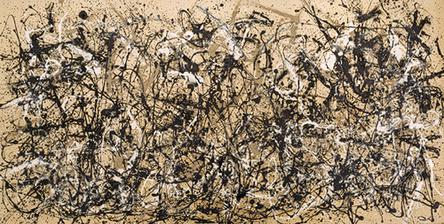
In October 1945, Pollock married American painter Lee Krasner, and in November they moved to what is now known as the Pollock-Krasner House and Studio, at 830 Springs Fireplace Road, in the Springs area of East Hampton, on Long Island, NY. Peggy Guggenheim lent them the down payment for the wood-frame house with a nearby barn that Pollock converted into a studio. There he perfected the technique of working with paint with which he would become permanently identified.Pollock was introduced to the use of liquid paint in 1936 at an experimental workshop operated in New York City by the Mexican muralist David Alfaro Siqueiros. He later used paint pouring as one of several techniques on canvases of the early 1940s, such as "Male and Female" and "Composition with Pouring I." After his move to Springs, he began painting with his canvases laid out on the studio floor, and he developed what was later called his "drip" technique, turning to synthetic resin-based paints called alkyd enamels, which, at that time, was a novel medium. Pollock described this use of household paints, instead of artist’s paints, as "a natural growth out of a need." He used hardened brushes, sticks, and even basting syringes as paint applicators. Pollock's technique of pouring and dripping paint is thought to be one of the origins of the term action painting. With this technique, Pollock was able to achieve a more immediate means of creating art, the paint now literally flowing from his chosen tool onto the canvas. By defying the convention of painting on an upright surface, he added a new dimension by being able to view and apply paint to his canvases from all directions. One possible influence on Pollock was the work of the Ukrainian American artist Janet Sobel (1894–1968) (born Jennie Lechovsky). Sobel's work is related to the so-called "drip paintings" of Jackson Pollock. Peggy Guggenheim included Sobel's work in her The Art of This Century Gallery in 1945. The critic Clement Greenberg, with Jackson Pollock, saw Sobel's work there in 1946, and in his essay "American-Type' Painting" Greenberg cited those works as the first instance of all-over painting he had seen, stating that "Pollock admitted that these pictures had made an impression on him".
In the process of making paintings in this way, he moved away from figurative representation, and challenged the Western tradition of using easel and brush. He also moved away from the use of only the hand and wrist, since he used his whole body to paint. In 1956, Time magazine dubbed Pollock "Jack the Dripper" as a result of his unique painting style.
My painting does not come from the easel. I prefer to tack the unstretched canvas to the hard wall or the floor. I need the resistance of a hard surface. On the floor I am more at ease. I feel nearer, more part of the painting, since this way I can walk around it, work from the four sides and literally be in the painting.Pollock observed Indian sandpainting demonstrations in the 1940s. Other influences on his dripping technique include the Mexican muralists and Surrealist automatism. Pollock denied "the accident"; he usually had an idea of how he wanted a particular piece to appear. His technique combined the movement of his body, over which he had control, the viscous flow of paint, the force of gravity, and the absorption of paint into the canvas. It was a mixture of controllable and uncontrollable factors. Flinging, dripping, pouring, and spattering, he would move energetically around the canvas, almost as if in a dance, and would not stop until he saw what he wanted to see.
I continue to get further away from the usual painter's tools such as easel, palette, brushes, etc. I prefer sticks, trowels, knives and dripping fluid paint or a heavy impasto with sand, broken glass or other foreign matter added.
When I am in my painting, I'm not aware of what I'm doing. It is only after a sort of 'get acquainted' period that I see what I have been about. I have no fear of making changes, destroying the image, etc., because the painting has a life of its own. I try to let it come through. It is only when I lose contact with the painting that the result is a mess. Otherwise there is pure harmony, an easy give and take, and the painting comes out well.
—Jackson Pollock, My Painting, 1956
Studies by Taylor, Micolich and Jonas have examined Pollock's technique and have determined that some works display the properties of mathematical fractals. They assert that the works become more fractal-like chronologically through Pollock's career. The authors even speculate that Pollock may have had an intuition of the nature of chaotic motion, and attempted to form a representation of mathematical chaos, more than ten years before "Chaos Theory" itself was proposed. Other experts suggest that Pollock may have merely imitated popular theories of the time in order to give his paintings a depth not previously seen.
In 1950, Hans Namuth, a young photographer, wanted to take pictures (both stills and moving) of Pollock at work. Pollock promised to start a new painting especially for the photographic session, but when Namuth arrived, Pollock apologized and told him the painting was finished.
The 1950s
Pollock's most famous paintings were made during the "drip period" between 1947 and 1950. He rocketed to popular status following an August 8, 1949 four-page spread in Life magazine that asked, "Is he the greatest living painter in the United States?" At the peak of his fame, Pollock abruptly abandoned the drip style.Pollock's work after 1951 was darker in color, including a collection painted in black on unprimed canvases. This was followed by a return to color, and he reintroduced figurative elements. During this period Pollock had moved to a more commercial gallery and there was great demand from collectors for new paintings. In response to this pressure, along with personal frustration, his alcoholism deepened.
From naming to numbering
Pollock wanted an end to the viewer's search for representational elements in his paintings, and so he abandoned titles and started numbering the paintings instead. Of this, Pollock commented: "...look passively and try to receive what the painting has to offer and not bring a subject matter or preconceived idea of what they are to be looking for." Pollock's wife, Lee Krasner, said Pollock "used to give his pictures conventional titles... but now he simply numbers them. Numbers are neutral. They make people look at a picture for what it is—pure painting."Death
Jackson Pollock's grave in the rear with Lee Krasner's grave in front in the Green River Cemetery.
 In 1955, Pollock painted Scent and Search which would be his last two paintings.Pollock did not paint at all in 1956.
After struggling with alcoholism for his entire adult life, Pollock, on
August 11, 1956, at 10:15 pm, died in a single-car crash in his Oldsmobile
convertible while driving under the influence of alcohol. One of the
passengers, Edith Metzger, was also killed in the accident, which
occurred less than a mile from Pollock's home. The other passenger,
Pollock's mistress Ruth Kligman, survived. After Pollock's demise at age 44, his widow, Lee Krasner,
managed his estate and ensured that Pollock's reputation remained
strong despite changing art-world trends. They are buried in Green River Cemetery in Springs with a large boulder marking his grave and a smaller one marking hers.
In 1955, Pollock painted Scent and Search which would be his last two paintings.Pollock did not paint at all in 1956.
After struggling with alcoholism for his entire adult life, Pollock, on
August 11, 1956, at 10:15 pm, died in a single-car crash in his Oldsmobile
convertible while driving under the influence of alcohol. One of the
passengers, Edith Metzger, was also killed in the accident, which
occurred less than a mile from Pollock's home. The other passenger,
Pollock's mistress Ruth Kligman, survived. After Pollock's demise at age 44, his widow, Lee Krasner,
managed his estate and ensured that Pollock's reputation remained
strong despite changing art-world trends. They are buried in Green River Cemetery in Springs with a large boulder marking his grave and a smaller one marking hers.

Hiç yorum yok:
Yorum Gönder